Independent reference
US gun policy, from the statutes and the cases
This is a neutral reading guide to federal firearm statutes, the kinds of laws states enact, and five Supreme Court decisions. It does not recommend policy. It does not report crime, injury, or ownership figures. Every factual claim is tied to a statute, public law, or court opinion.
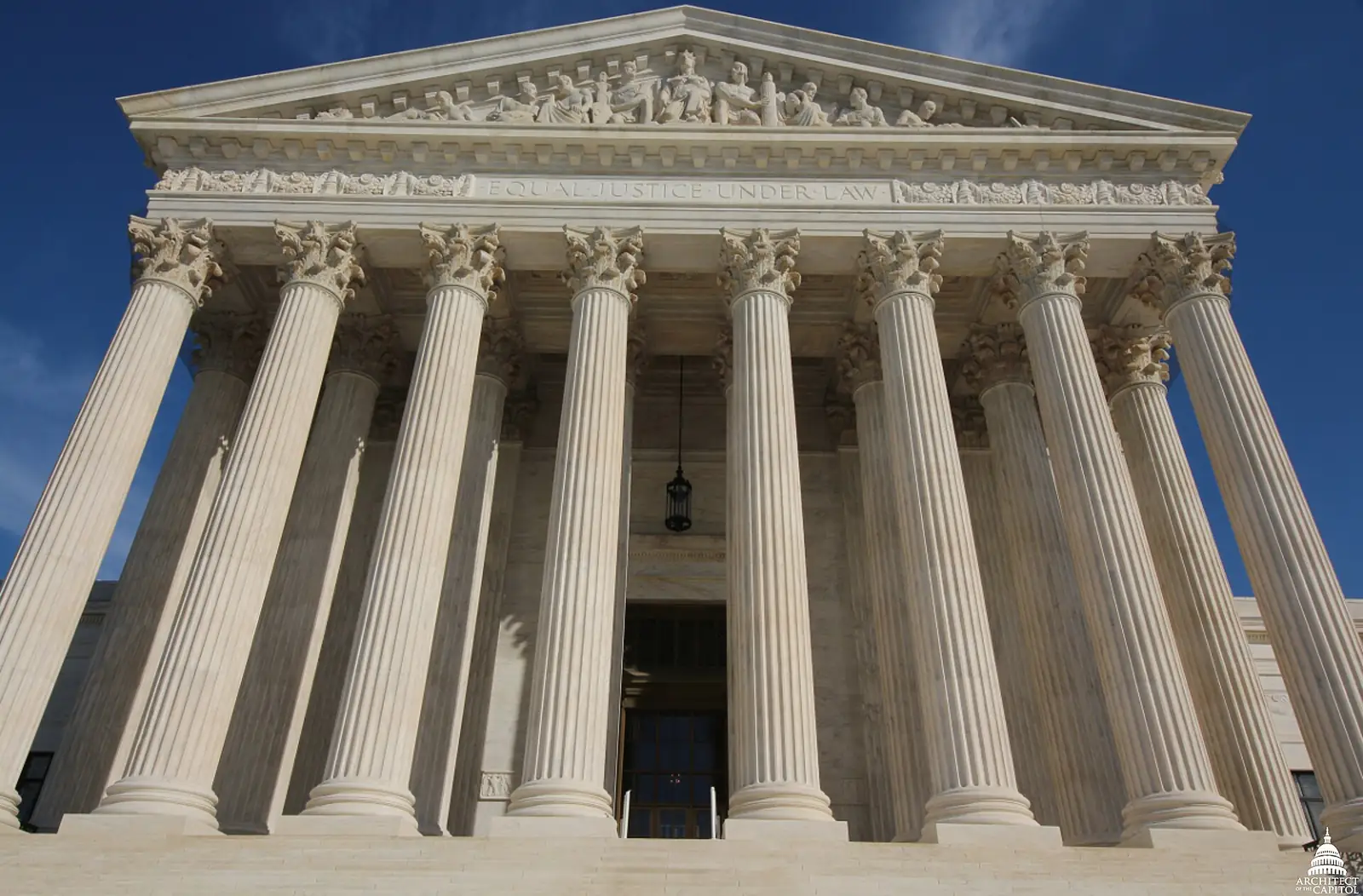
Photograph: Architect of the Capitol, “Supreme Court Following Facade Restoration,” October 28, 2013. Public domain, a work of the United States government. Wikimedia Commons.

The constitutional sentence
A well regulated Militia, being necessary to the security of a free State, the right of the people to keep and bear Arms, shall not be infringed.
What that sentence protects, and what legislatures may still regulate, is set out in the Court’s opinions, not on this page’s own authority. The five cases covered here are United States v. Miller, District of Columbia v. Heller, McDonald v. Chicago, New York State Rifle & Pistol Association v. Bruen, and United States v. Rahimi.2
Two federal statutes, then the states
Congress’s main firearm statutes are the Gun Control Act, codified in chapter 44 of title 18 of the United States Code, and the National Firearms Act, codified in chapter 53 of title 26.3 Chapter 44 states that Congress did not intend to occupy the field and exclude state law on the same subject, unless a federal provision and a state law are in direct and positive conflict.4 State codes are therefore part of the operative law. They are not collected into one national statute.
How to read a page
A superscript number goes to a note. The note names the statute, public law, or opinion and links to the government’s own copy when one is posted. Where the Office of the Law Revision Counsel’s section pages were unavailable, the note also links a nongovernmental reading copy of the same section and says so.5 Nothing here is a substitute for the text it cites, and nothing here is legal advice about a particular person, firearm, or transfer.
Notes
- National Archives, “The Bill of Rights: A Transcription,” Amendment II, archives.gov/founding-docs/bill-of-rights-transcript. ↩
- The opinions and the pages that quote them are listed on Supreme Court cases. ↩
- Gun Control Act of 1968, Pub. L. No. 90-618, 82 Stat. 1213 (Oct. 22, 1968), 82 Stat. 1213 (govinfo). National Firearms Act, ch. 757, 48 Stat. 1236 (June 26, 1934), 48 Stat. 1236 (govinfo). The current codifications are 18 U.S.C. ch. 44 and 26 U.S.C. ch. 53. ↩
- 18 U.S.C. § 927. Office of the Law Revision Counsel, United States Code, current through Public Law 119-120 (October 7, 2026), uscode.house.gov. Reading copy checked October 14, 2026: Legal Information Institute, 18 U.S.C. § 927. ↩
- The rule for sources is stated on the sources and methodology page. ↩